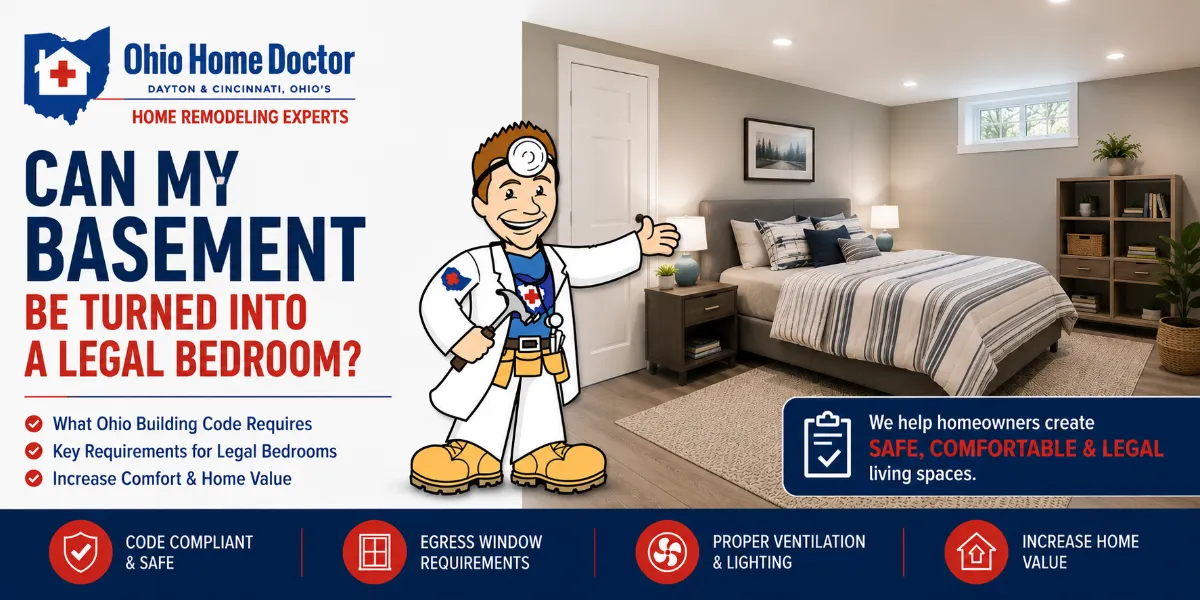
Can My Basement Be Turned Into A Legal Bedroom?
One of the most common questions homeowners ask when planning a basement remodel is surprisingly simple:
"Can we put a bedroom down there?"
Whether you're trying to create space for a growing family, accommodate overnight guests, build an in-law suite, or simply make better use of your basement, adding a bedroom is often one of the first ideas homeowners consider.
In fact, many of the basement remodeling inquiries we receive throughout Dayton, Centerville, Beavercreek, Bellbrook, Springboro, Miamisburg, Oakwood, West Chester, and surrounding Southwest Ohio communities involve adding bedrooms, guest suites, basement bathrooms, and additional living space.
The good news is that many basements can be converted into comfortable, functional bedrooms.
However, simply placing a bed in the basement doesn't automatically create a legal bedroom.
Building codes exist to protect homeowners and occupants, and there are several important requirements that must be considered before a basement bedroom can be considered code compliant.
If you're thinking about adding a bedroom to your basement, here's what you need to know.
Why Homeowners Add Bedrooms To Their Basements
Most homeowners aren't finishing a basement bedroom just because they have extra space available.
They're usually trying to solve a problem.
Common reasons homeowners add basement bedrooms include:
-
- Growing families
- Teenagers wanting more privacy
- Hosting overnight guests
- Creating in-law suites
- Accommodating adult children
- Increasing usable living space
- Improving resale appeal
For many homeowners, the basement represents the largest area of untapped square footage in the home. Rather than moving to a larger house, finishing the basement can often provide the additional space a family needs at a significantly lower cost.
What Makes A Basement Bedroom "Legal"?
A legal bedroom is more than four finished walls and a door.
To meet building code requirements, a basement bedroom must satisfy certain safety and habitability standards.
While requirements can vary based on local building codes and the specific characteristics of the home, common considerations include:
- Emergency escape access
- Proper ceiling height
- Heating and ventilation
- Electrical requirements
- Building permits and inspections
These requirements exist primarily to protect occupants in the event of an emergency while ensuring the space is safe and comfortable for everyday use.
Do Basement Bedrooms Need Egress Windows?
In most cases, yes.
This is often the single biggest obstacle homeowners encounter when planning a basement bedroom.
An egress window provides an emergency escape route if occupants cannot exit through the home's primary exits.
It also allows emergency personnel to enter the room if necessary.
In addition to safety, egress windows provide valuable:
-
- Natural light
- Fresh air
- Ventilation
- Improved comfort
Many older basements were not originally built with egress windows large enough to satisfy current code requirements.
Fortunately, installing an egress window is often possible and has become a common part of basement remodeling projects.
Many homeowners are surprised by how much brighter and more inviting a basement bedroom feels once an egress window is installed.
What About Ceiling Height?
Another important consideration is ceiling height.
Many older Ohio homes have basements that were never intended to serve as finished living space.
As a result, homeowners often encounter:
-
- Low ceilings
- Exposed beams
- Ductwork
- Plumbing lines
- Mechanical equipment
Building codes establish minimum ceiling height requirements for habitable living spaces. These requirements help ensure the room feels comfortable and safe for occupants.
The good news is that many basements already meet these requirements or can be modified to do so during the remodeling process.
Before planning a basement bedroom, it's important to evaluate existing conditions to determine what options are available.
Does A Basement Bedroom Need Heating And Cooling?
Yes.
A basement bedroom should be comfortable year-round.
This typically means providing adequate heating and, where applicable, cooling and air circulation.
Homeowners sometimes assume that because the basement remains cooler than the rest of the house, additional HVAC considerations aren't necessary.
However, every bedroom should be able to maintain comfortable temperatures throughout the year.
Depending on the home's existing HVAC system, solutions may include:
-
- Extending ductwork
- Adding returns
- Supplemental heating
- Improved ventilation
Addressing these items during the remodeling process helps create a space that feels like part of the home rather than an afterthought.
Do Basement Bedrooms Need Closets?
This is one of the most common misconceptions surrounding basement bedrooms.
Many people believe a closet is the primary requirement for a legal bedroom.
In reality, local code requirements focus much more heavily on safety factors such as emergency egress and habitability.
While closets are certainly desirable and often expected by homeowners and buyers, they are not always the determining factor in whether a room qualifies as a bedroom.
A properly designed basement bedroom should focus first on safety, comfort, and functionality.
Do I Need A Permit To Add A Basement Bedroom?
In most cases, yes.
Finishing a basement bedroom often involves:
-
- Framing
- Electrical work
- HVAC modifications
- Insulation
- Drywall
- Egress windows
Permits and inspections help ensure that the work complies with current building codes and safety standards.
While permits can sometimes feel like an inconvenience, they ultimately help protect homeowners and can prevent issues during future home sales.
A professional remodeling contractor should be familiar with local permitting requirements and guide you through the process.
Can A Basement Bedroom Increase Home Value?
While every home and real estate market is different, additional usable living space is generally attractive to buyers.
A finished basement bedroom may provide benefits such as:
-
- More sleeping space
- Guest accommodations
- Flexibility for growing families
- Additional functionality
- Improved marketability
The value added depends on many factors, including the quality of the renovation, the home's location, and the overall layout.
While homeowners shouldn't remodel solely for resale value, a professionally finished basement bedroom is often viewed as a desirable feature.
Can A Basement Bedroom Become Part Of A Guest Suite Or In-Law Suite?
Absolutely.
Many homeowners don't stop at adding a bedroom.
Instead, they create an entire guest suite or private living area within the basement.
Depending on the available space, a basement suite may include:
- Bedroom
- Bathroom
- Living room
- Storage area
- Home office
- Kitchenette
This type of setup can work particularly well for:
-
- Aging parents
- Visiting relatives
- Adult children
- Long-term guests
In fact, many homeowners who contact us about basement remodeling are specifically looking to create flexible spaces that can serve multiple purposes as their family's needs change over time.
How Much Does It Cost To Add A Basement Bedroom?
The answer depends on several factors.
Some of the biggest cost considerations include:
-
- Egress window installation
- HVAC modifications
- Electrical work
- Insulation
- Drywall and finishes
- Flooring
- Existing basement conditions
A basement that already has proper ceiling height and an existing egress window may require significantly less work than one starting from scratch.
If you're considering a basement remodeling project, we recommend reviewing our Basement Finishing Cost Guide to better understand typical investment ranges and what factors influence overall project costs.
Is A Basement Bedroom Right For Your Home?
For many homeowners, the answer is yes.
Whether you're creating space for family members, accommodating guests, building an in-law suite, or simply trying to maximize the usable square footage in your home, a basement bedroom can be a valuable addition.
The key is making sure the space is designed properly, built safely, and complies with applicable building requirements.
A well-planned basement bedroom should feel every bit as comfortable and functional as any bedroom on the main floor.
Thinking About Finishing Your Basement?
Ohio Home Doctor helps homeowners throughout Dayton, Centerville, Beavercreek, Bellbrook, Springboro, Miamisburg, Oakwood, West Chester, and surrounding Southwest Ohio communities transform unfinished basements into beautiful, functional living spaces.
Whether you're considering a basement bedroom, guest suite, home office, bathroom, or complete basement remodel, our team can help you understand what's possible and create a plan that fits your goals and budget.
Contact Ohio Home Doctor today to schedule a consultation and start exploring the possibilities hidden beneath your home.